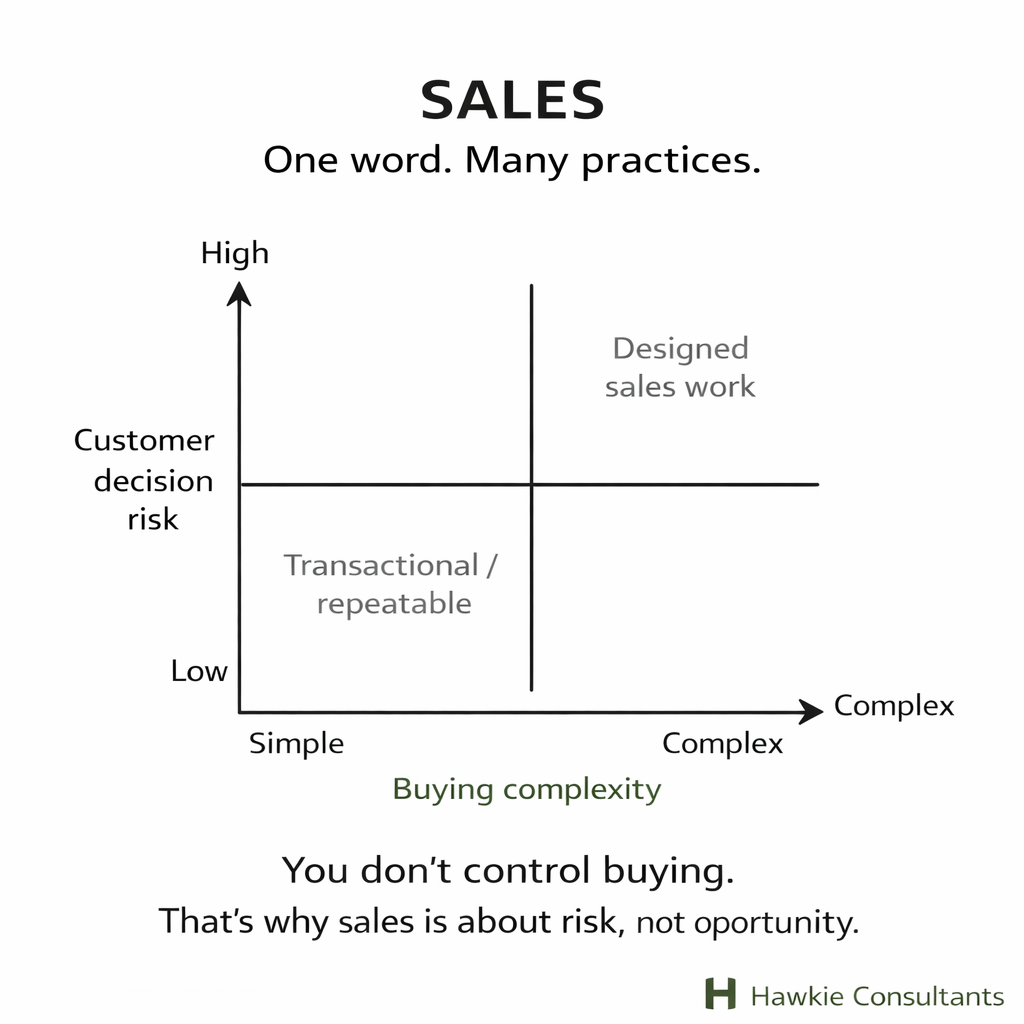
Where Sales Risk Is Created
Sales creates commitments you don’t control.
Inside the organization, goals are set, budgets are approved, capacity is planned, and forecasts are believed. At the same time, the decision that validates all of this is owned by the customer.
That gap is the risk.
Sales is where the organization begins to act as if an outcome were already decided, even though it isn’t.
This is what sales actually does inside a company. It is the point where internal certainty starts to form. Plans harden, resources are allocated, and expectations settle — all before the customer has made a decision.
You don’t control buying. That is why sales is about risk, not opportunity.
Buying sets the conditions you must respond to.
Customers do not decide by optimizing upside. They decide by managing exposure. Their real question is not “What do we gain?” but “Is changing riskier than staying as we are?”
As long as the answer is yes, the status quo holds.
That is not indecision. It is rational behavior.
Internal risk is created when organizations assume customers decide on value, ROI, or urgency. Based on those assumptions, they commit too early. Internally, certainty increases. Externally, nothing has changed.
That mismatch — internal commitment without external decision — is where sales risk accumulates.
Risk increases when organizations try to manufacture certainty through forecasts that are, by nature, uncertain.
Pipelines and CRM give exact numbers about decisions they do not control.
Selling follows buying.
When buying is simple, sales can be standardized. When buying is complex, sales must be deliberately designed. Treating all sales the same is what breaks forecasts, behavior, and trust.